
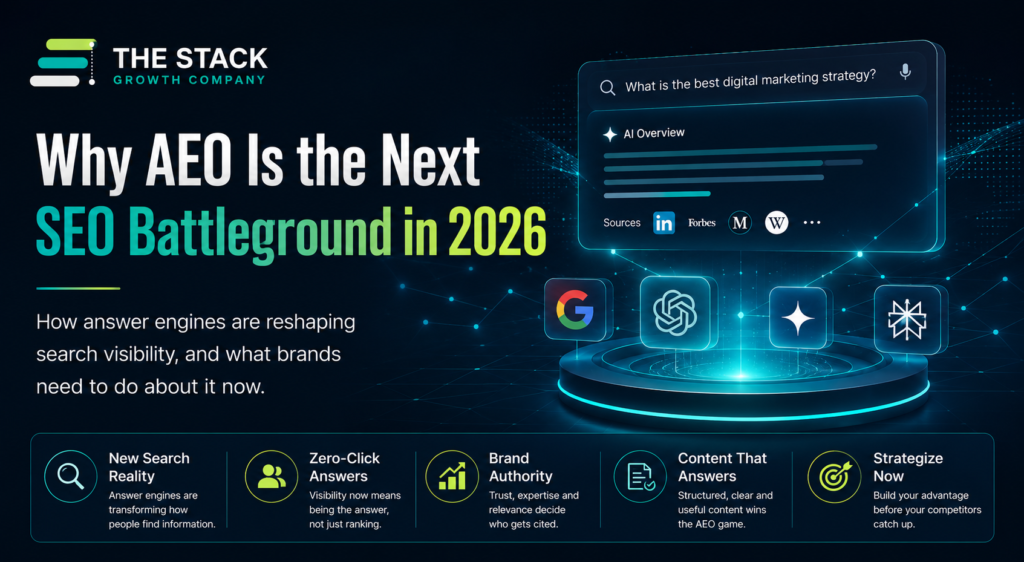
How answer engines are reshaping search visibility – and what brands need to do about it now.
Search used to end with a click.
You typed a query into Google, scanned the results, clicked a website and started reading.
In 2026, that journey is changing.
People are increasingly asking longer, more conversational questions and getting synthesized answers from AI-powered search experiences. Google AI Overviews and AI Mode are changing how information is discovered inside Search, while tools such as ChatGPT, Gemini and Perplexity are becoming part of the research journey.
That creates a new question for marketers:
What happens when being visible is no longer just about ranking a page – but becoming part of the answer?
That’s where Answer Engine Optimization (AEO) enters the conversation.
What is AEO?
Answer Engine Optimization is an emerging industry term for making a brand’s content easier for AI-powered answer systems to understand, retrieve, evaluate and potentially cite when responding to a user’s question.
It isn’t a replacement for SEO.
In fact, Google made that distinction clear in its May 2026 guidance: there are no additional technical requirements or special optimizations required to appear in AI Overviews or AI Mode. The fundamentals of SEO still matter.
Think of it this way:
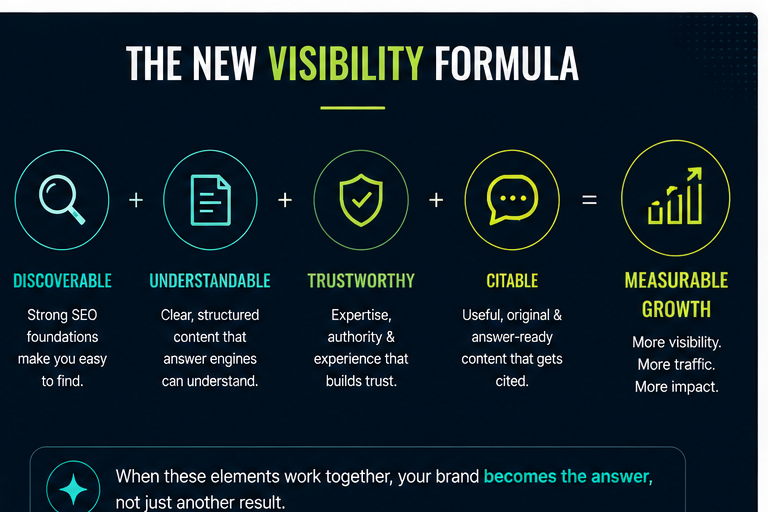
- SEO helps your content become discoverable.
- AEO focuses on making that content useful as an answer.
The two increasingly overlap.
Search is moving from keywords to questions!
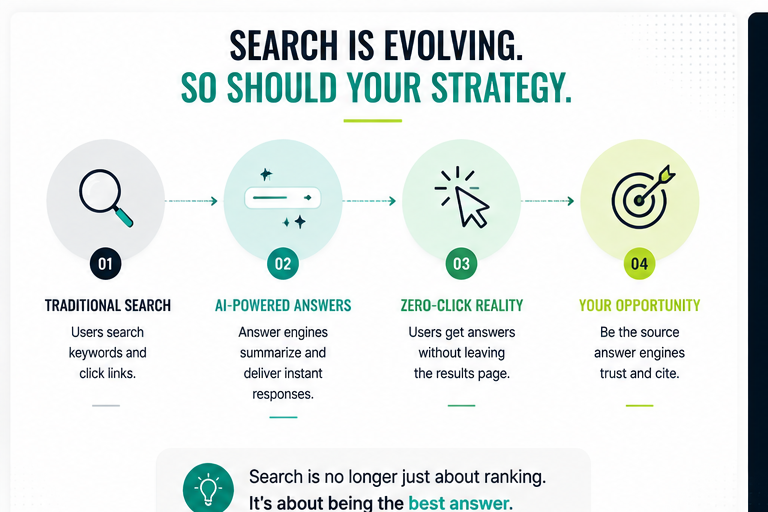
Traditional search often looked like: “digital marketing strategy”
An answer-engine journey might look more like: “What digital marketing strategy should a B2B SaaS company use to generate qualified leads in 2026?”
The second query contains more context, intent and expectations.
That means brands need to understand not only what people search for, but also:
- What questions they ask
- What problems they are trying to solve
- What information they need before making a decision
- Which claims require evidence
- Which sources they trust
This is where SEO and content marketing increasingly need to work together.
A keyword can tell you what someone searches. A strong content strategy helps you understand why they searched it.
Why ranking alone isn’t enough anymore?
A page can rank well and still lose part of the user’s attention if an AI-generated answer satisfies the query before the click happens.
That doesn’t mean organic search is disappearing. It means the definition of visibility is expanding.
Google’s own documentation describes AI Overviews and AI Mode as experiences that synthesize information while still surfacing links that help users explore sources further.
So the goal isn’t:
SEO → rank → done.
It is becoming:
Discover → understand → answer → earn trust → convert.
Brands that continue measuring visibility only through rankings may miss an important part of that journey.
What makes content more useful to answer engines?
There is no magic “AEO checklist” that guarantees citations & that’s an important point.
Google’s latest guidance specifically warns against treating AEO or GEO as a separate technical trick. Instead, it emphasizes valuable, unique, non-commodity content and says established SEO best practices remain foundational.
That gives brands a much more practical starting point.
1. Answer the question clearly
Don’t make readers dig through five paragraphs to find the answer. Start sections with a direct explanation, then provide context, evidence and examples.
2. Build topical depth
One article rarely establishes authority. A stronger content marketing strategy connects related topics into a useful knowledge structure.
3. Add original thinking
Generic summaries are becoming increasingly easy to produce. Original research, proprietary data, first-hand experience, expert commentary, examples and strong opinions are much harder to replicate.
Google’s people-first guidance specifically asks whether content provides original information, research, analysis or insights beyond what already exists.
4. Make your expertise visible
- Who created the content?
- Why should they be trusted?
- What experience do they have?
Clear authorship, relevant expertise and evidence help both readers and search systems understand the credibility behind a piece of content.
5. Keep the technical foundation strong
This part hasn’t changed.
Crawlability. Indexability. Internal linking. Useful page structure. Structured data where appropriate. Fast, accessible experiences.
Google explicitly states that the same foundational SEO practices remain relevant for AI search experiences.
AEO doesn’t mean writing for machines!
This is probably the biggest misconception. You shouldn’t turn every article into a collection of robotic Q&As simply because AI systems can extract answers.
The better approach is to make the content clearer for humans first.
- Write the answer clearly.
- Explain the reasoning.
- Show evidence.
- Add examples.
- Bring an original point of view.
Then structure the page so both people and machines can understand it. That’s also consistent with Google’s people-first content guidance: content should primarily exist to help an intended audience, rather than being created mainly to manipulate search rankings.
What brands should do now?
The opportunity isn’t to abandon SEO and suddenly launch an “AEO strategy.” It’s to strengthen the foundation you already have. Start by auditing your most important pages.
Ask:
- Can someone understand exactly what we do within seconds?
- Do our pages answer the questions our customers actually ask?
- Do we demonstrate real expertise?
- Are our claims supported by evidence?
- Do our articles connect logically through internal links?
- Are we building authority beyond our own website?
And perhaps most importantly:
If an AI system had to explain our company to a potential customer, would our website give it enough accurate information to do that well?
Ending Note
SEO isn’t dying. The battlefield is expanding.
Search visibility used to mean: “Where does my page rank?”
Now brands also need to think about: “Where does my brand appear when someone asks the question?”
That shift doesn’t make SEO less important. It makes good SEO, strong content marketing and genuine expertise more important. The brands that win won’t be the ones that chase every new acronym.
They’ll be the ones that build useful content, establish authority, understand their audience and make their information easy to discover, understand and trust.
In 2026, don’t just optimize to be found. Build a brand worth being the answer.
The Stack Growth Company helps ambitious brands connect SEO, content strategy and digital marketing into one connected growth system.