The way people discover information online is evolving. Instead of relying entirely on traditional search results, users are increasingly interacting with AI-powered search experiences to ask questions, explore topics and compare solutions.
Google AI Overviews provide AI-generated summaries within search results, while AI Mode offers a more conversational experience that allows users to explore questions in greater depth. For businesses, this creates an important opportunity—and a new challenge.
Your website needs to do more than attract visitors through traditional keyword rankings. It must also provide useful, accessible and well-structured information that search engines can understand.
So, how can you optimize your website for Google AI Overviews and AI Mode in 2026?
The answer is not a secret ranking technique or a new collection of AI-specific tricks. It starts with strong SEO fundamentals, helpful content, technical accessibility and a clear understanding of what your audience wants to know.
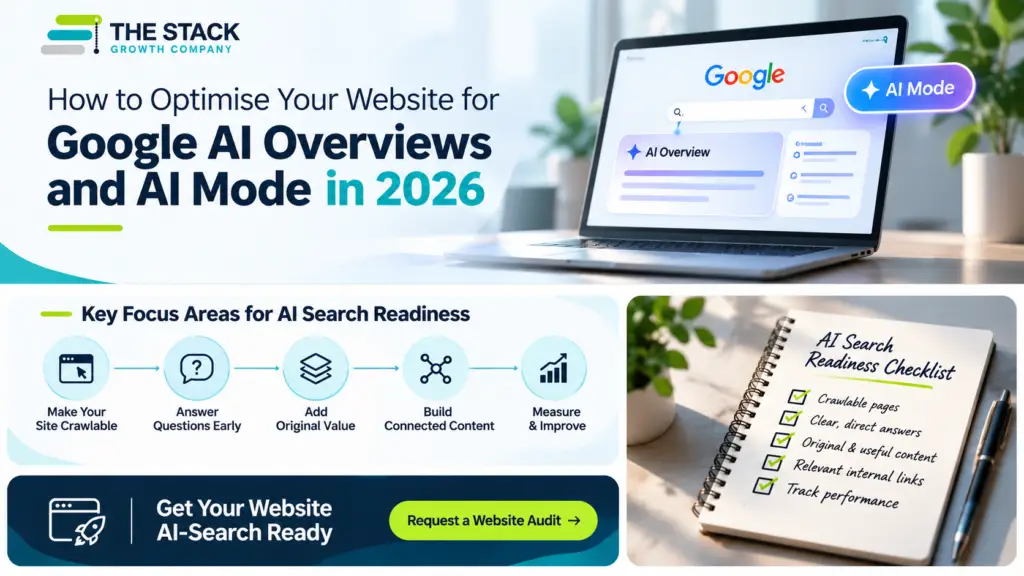
Here are five practical areas to focus on.
1. Make Your Website Easy for Google to Crawl and Understand
Before your content can appear in Google Search, Google needs to discover, crawl and potentially index your pages. This remains fundamental to AI-powered search experiences as well.
Even the most informative article may struggle to gain visibility if search engines cannot access its content. Start by reviewing your website’s technical SEO. Here are some important checks:
Check your robots.txt file: Ensure important pages are not accidentally blocked from crawling.
Review no-index directives: Make sure pages intended for search visibility do not contain unintended no-index tags.
Use an XML sitemap: Submit an updated sitemap through Google Search Console to help Google discover important URLs.
Maintain a logical website structure: Organize content into relevant categories and use descriptive URLs.
Check canonical tags: Avoid sending conflicting signals about which version of a page should be indexed.
Test JavaScript rendering: Ensure important content, links and metadata are accessible when Google renders your pages.
For example, if your business offers Salesforce consulting services, your website should have clearly accessible pages explaining your services, solutions, industry expertise and relevant use cases.
A well-structured website makes it easier for both visitors and search engines to understand what your business offers.
Remember: crawlability and indexing make your pages eligible for consideration. They do not guarantee rankings or inclusion in AI-generated results.
2. Answer Your Audience’s Questions Clearly and Early
One of the most practical ways to improve content quality is to answer the reader’s main question without unnecessary delays. Think about how people search today. Someone researching CRM integration might ask:
What is CRM integration?
How does CRM integration improve business operations?
Can Salesforce and HubSpot work together?
What are the challenges of integrating multiple CRM platforms?
Your content should address these questions naturally and provide enough context to help readers make informed decisions.
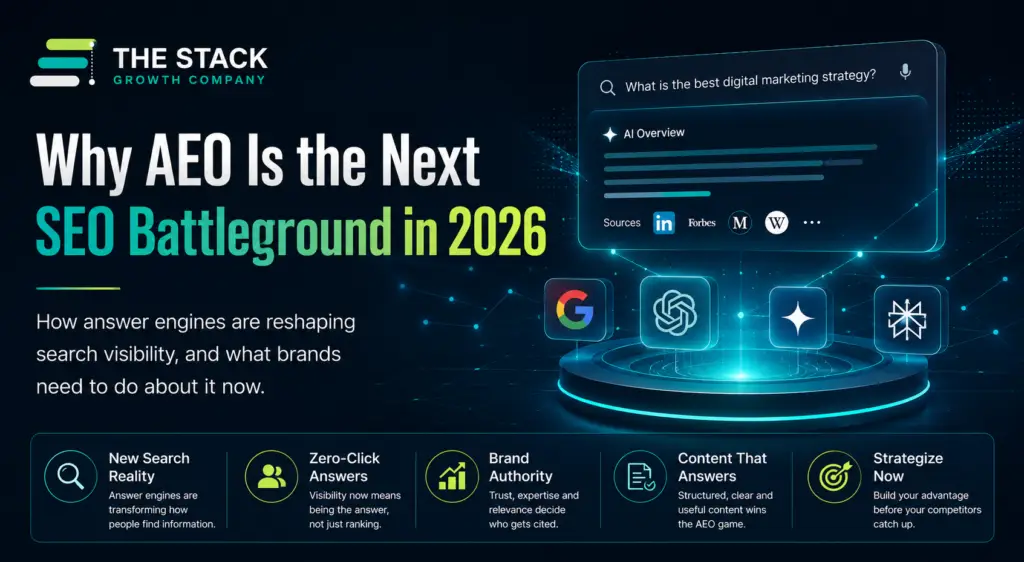
You May Also Read: https://thestackgrowthcompany.com/why-aeo-is-the-next-seo-battleground-in-2026/
Start with a direct answer. Explain the main concept in a few sentences.
Add supporting details. Cover the process, benefits, challenges and relevant considerations.
Include practical examples. Show how the concept applies to real business situations.
Use descriptive headings. Organize information into sections that are easy to scan and understand.
For instance, an article about CRM integration should first explain what CRM integration means before discussing APIs, data synchronization, security and implementation. Avoid lengthy introductions, repetitive keyword placement and unnecessary paragraphs. The objective is simple: make your content genuinely useful to someone looking for an answer.
3. Publish Original Content That Builds Trust
AI tools can generate information quickly. However, publishing more content does not automatically make a website more valuable.
When similar articles repeat the same general advice, they offer readers very little reason to choose one source over another.
This is where original insights and credible information become important.
Instead of simply explaining what a technology does, demonstrate how it works, where it creates value and what businesses should consider before adopting it.
For example, an article about AI-powered marketing automation could include:
A practical campaign workflow.
Examples of how customer data supports personalisation.
Common implementation challenges.
Expert observations from real projects.
A checklist for evaluating automation readiness.
Support factual claims with reliable sources, particularly when discussing product capabilities, technical specifications, statistics or industry developments.
If you mention a Salesforce or HubSpot feature, refer to the relevant official documentation. If a feature is available only in selected editions or regions, make that limitation clear.
You should also distinguish between verified facts, professional opinions and predictions.
Google’s guidance emphasizes helpful, reliable, people-first content. Its policies do not prohibit AI-assisted writing, but producing large volumes of low-value content primarily to manipulate search rankings can fall under its scaled content abuse policy.
The goal should not be to publish more. It should be to publish something worth reading.
4. Build Topic Authority Through Connected Content
A single blog can answer a question, but a connected collection of useful resources can help demonstrate the depth of your expertise.
This is where a well-planned content strategy makes a difference. Suppose your business offers digital marketing and Salesforce consulting services. Instead of publishing unrelated articles, create connected content around broader topics.
For example:
Main topic: AI and Digital Marketing
Supporting articles:
How AI Is Changing Digital Marketing.
What Is Answer Engine Optimization?
How to Prepare Your Website for AI Search.
The Role of First-Party Data in AI Personalisation.
How Marketing Automation Improves Customer Engagement.
Connect these articles through relevant internal links.
For example, an article about AI search optimisation could link to your SEO services page, while a blog about customer data could direct readers to your CRM and automation resources.
Use descriptive anchor text so readers understand what they will find when they follow a link.
Also, avoid publishing multiple pages that target exactly the same search intent without offering a meaningful difference. If two articles overlap heavily, consider improving or consolidating them.
Structured data can also help search engines interpret eligible content types. However, adding schema does not guarantee better rankings, rich results or AI citations. It must accurately represent the visible content on your page.
5. Measure What Matters and Improve Continuously
SEO and AI search optimisation are not one-time activities. They require regular monitoring and improvement. Start with Google Search Console to understand how your website performs in Google Search.
Track important metrics such as:
Impressions: How frequently your pages appear in search results.
Clicks: How many users visit your website through search.
Click-through rate: The percentage of impressions that generate clicks.
Average position: An indicator of your page’s search visibility.
Indexing status: Whether Google has indexed your important pages.
Use Google Analytics or another analytics platform to understand what happens after visitors reach your website.
Monitor engaged sessions, enquiry submissions, demo requests, contact form completions and other meaningful conversions.
You can also use third-party AI search monitoring tools to observe how your brand appears across selected AI platforms. However, treat these results as directional rather than definitive. AI-generated responses can change depending on the platform, prompt, location and time.
The most important question is not simply whether your website receives more impressions. It is whether your content attracts the right audience and contributes to meaningful business outcomes.
Conclusion: Build for People First, Optimise for Search Everywhere
Google AI Overviews and AI Mode represent an evolving approach to information discovery. Businesses should pay attention to these developments, but they should not abandon the SEO practices that make websites useful and discoverable.
Focus on making your website technically accessible, answering questions clearly, publishing original insights and building meaningful connections between your content.
Most importantly, understand your audience before creating content for search engines.
At The Stack Growth Company, we believe sustainable digital visibility comes from combining strong SEO foundations, valuable content and a strategy that adapts to changing search behaviour.
Want to strengthen your website’s SEO and AI-search readiness? Let’s assess your technical discoverability, content structure and customer journey to identify opportunities for sustainable digital growth.
Frequently Asked Questions
1. Do I need special schema markup for Google AI Overviews?
No. Google does not specify additional technical requirements or special schema markup specifically for AI Overviews or AI Mode. Your website must meet Google’s normal Search eligibility requirements and follow established SEO fundamentals.
2. Does AEO replace traditional SEO?
No. Answer Engine Optimization (AEO) complements traditional SEO by focusing on how content answers questions and supports discovery across AI-powered experiences. Technical SEO, useful content and website accessibility remain important.
3. Can I guarantee that my website will appear in Google AI Overviews?
No. Meeting technical requirements does not guarantee crawling, indexing, rankings or inclusion in AI-generated results. Google determines which content appears for individual searches.
4. Should I create a separate blog for every search query?
Not necessarily. Create separate pages when there is a distinct user need or a meaningful difference in search intent. Publishing large numbers of repetitive, low-value pages can harm content quality and potentially violate Google’s scaled content abuse policies.